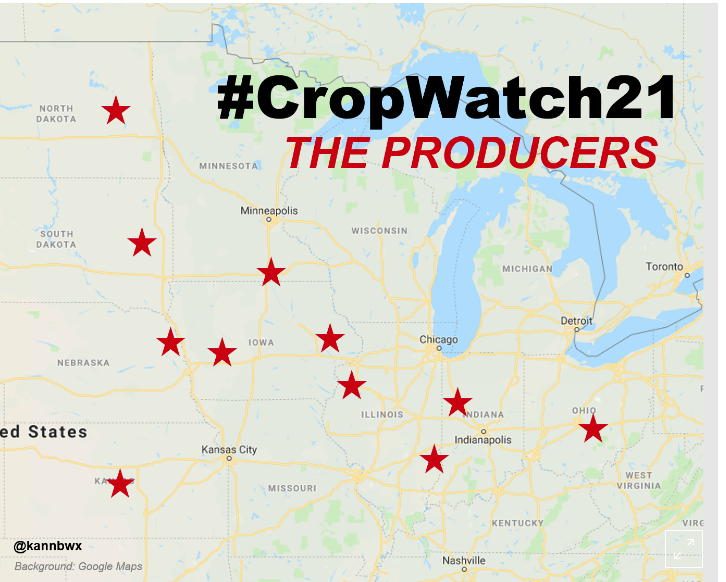
Reuters #CropWatch21 locations.
FORT COLLINS, Colo. (Reuters) – Last week’s rainfall was more generous in the western U.S. Corn Belt than in the east, opposite from the general trend so far this season, but prolonged dryness has forced some of the Crop Watch producers to trim yield expectations.
Those expectations remain above average and are within range of Crop Watch yield scores in the same weeks in 2018 and 2020, but the rain-plagued 2019 season carried lower ratings.
As of early Monday, seven-day rainfall totals were the best in western Iowa (1.6 inches; 41 mm) and Kansas (1.2 inches). Saturday night’s rain in Kansas was the first measurable rain in those fields since July 1. The Minnesota and Nebraska fields also tallied an inch during the week.
Eastern Iowa and western Illinois observed just tenths of an inch and South Dakota received an inch at best. No rain fell in North Dakota, Indiana or Ohio. Southeastern Illinois also had zero rain on the week until nearly 2 inches came down on Monday morning.
Top-end yields in some cases have likely slipped away or may imminently do so because of too many dry weeks this summer. Some of the producers with the strongest yield potential, including those in eastern Iowa, Indiana and Ohio, are now questioning that possibility.
The situation is mostly unchanged in North Dakota where severe drought long ago erased hopes for a good crop. The grower reports shallow kernel depth on the corn and flat soybean pods with mostly 1-2 seeds per pod instead of the desired 3-4.
Forecasts early on Monday suggested the drier trend may continue this week in western areas. Rain chances are better in the east but amounts and location vary by model.
Hotter temperatures early this week should give way to cooler temperatures by the weekend, and most of the Corn Belt is expected to observe more seasonal weather through next week.
RATINGS TRIM
The 11 Crop Watch producers each week rate corn and soybean yield potential in their subject fields on a 1-to-5 scale. A 1 for yield potential reflects expectations for well below average yields, while 4 would indicate above average and 5 well above average or record.
Three producers this week reduced corn yield potential (Minnesota, eastern Iowa and Indiana) and two increased it (Nebraska and western Iowa). That lowered the 11-field, unweighted corn yield average to 3.91 from 3.95 last week and the adjustments reflected where rain was and was not received.
Soybean yield potential fell slightly to 3.8 from 3.82 as small bumps in Nebraska and western Illinois were offset by declines in Minnesota and Indiana. Only 5 of the producers hold soybean yield scores at 4 or above, but that is true for 7 of the 11 on corn.
The corn and soybean yield scores are about 0.2 point below the 8-field average from the same week in 2020, before the derecho came and the drought impacts set in. They are a bit closer to the 8-field averages from 2018.
Corn conditions slid to 4.02 from 4.09 last week as dry weather cut crop health in Minnesota and Indiana. Soybean conditions also fell in those states, dropping the 11-field average to 3.91 from 3.95. Those declines were balanced by slight increases in western Iowa corn and Nebraska soybeans.
The crop condition scores will be discontinued after this week to focus on yield scores. Plants dry down and turn colors naturally as the crops begin to mature, so conditions as they are used in Crop Watch will be less telling going forward.
The following are the states and counties of the 2021 Crop Watch corn and soybean fields: Griggs, North Dakota; Kingsbury, South Dakota; Freeborn, Minnesota; Burt, Nebraska; Rice, Kansas; Audubon, Iowa; Cedar, Iowa; Warren, Illinois; Crawford, Illinois; Tippecanoe, Indiana; Fairfield, Ohio.
Photos of the 22 Crop Watch fields can be tracked on Twitter by following @kannbwx.
The opinions expressed here are those of the author, a market analyst for Reuters.