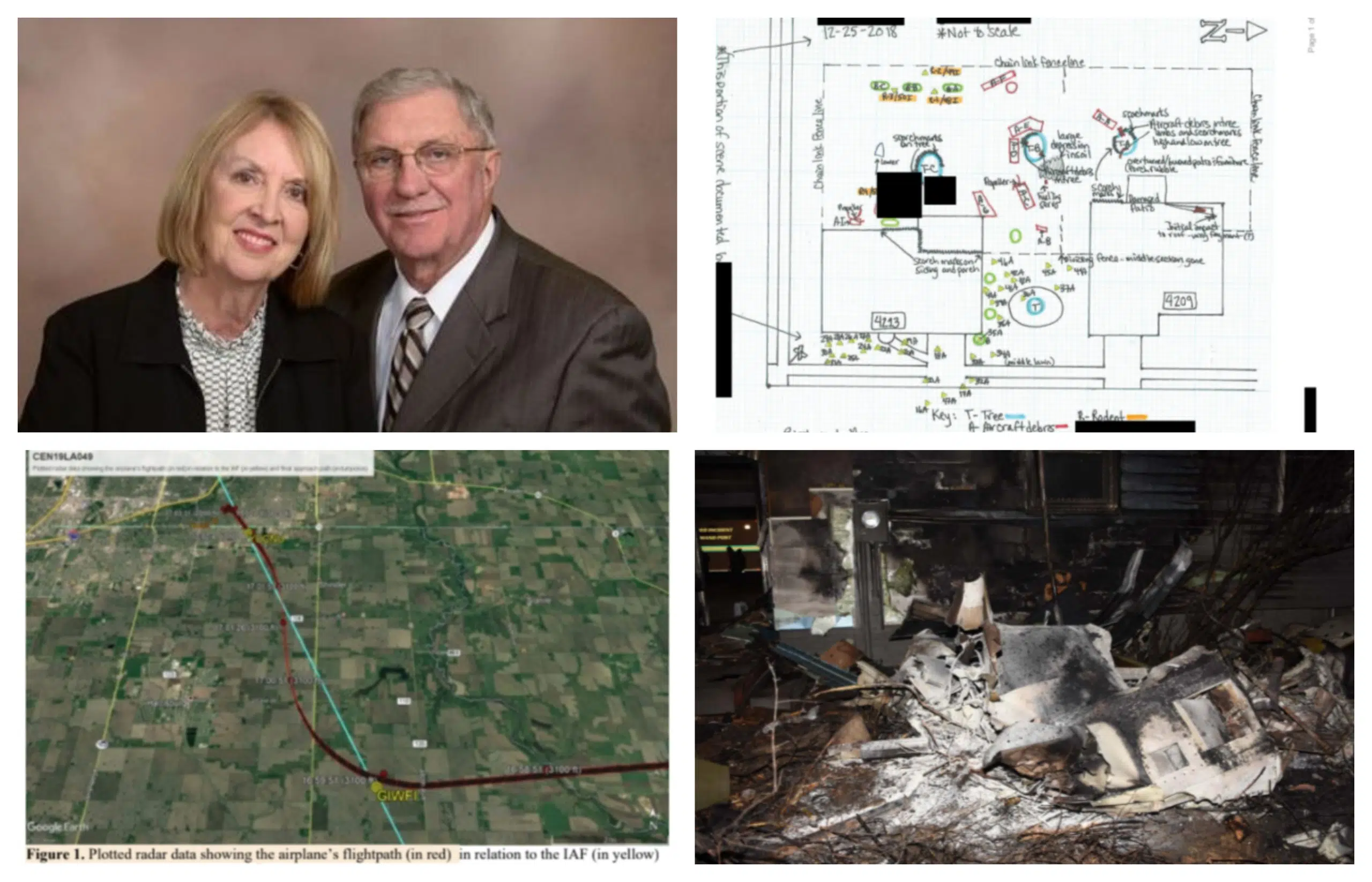
From upper left clockwise: JoAnn and Vaughn Meyer; Sioux Falls Police diagram of the crash scene; SFPD photo of the crash scene; and Meyer's approach to FSD Runway 33.
SIOUX FALLS, S.D. (KELO.com) — One thing is certain: The twin-engine Beechcraft 58P, N6745V, piloted by Dr. Vaughn Meyer crashed, broke apart, and caught fire in a Sioux Falls neighborhood Christmas night in 2018.
The fiery crash killed Meyer and his wife JoAnn, barely missing homes.
In records from the National Transportation Safety Board updated this month, almost two years later, it still isn’t entirely clear why a mostly healthy, 68-year-old, experienced pilot in an airworthy aircraft in decent weather crashed five miles short of Joe Foss Field.
Even the autopsy doctors cannot agree on whether Meyer, a respected Sioux Falls plastic surgeon, suffered a heart attack that may have precipitated the crash.
The NTSB “Medical Factual Report” issued Nov. 6, 2019, notes that the immediate cause of death for Meyer was “multiple blunt force injuries” from the impact. The autopsy performed by the Sanford Health Pathology Clinic said it determined that “section of the left ventricle (of the heart) had widespread contraction band necrosis without inflammatory response; coronary arteres had atherosclerotic plaques with calcification; a few areas of thermal injury to myocytes were noted.”
Then this:
“The pathologist gave the pilot (Meyer) an additional diagnosis of acute myocardial infarction (ongoing, acute heart attack) based on his cardiac evaluation.”
However, a review by the Office of the Armed Forces Medical Examiner was skeptical, as was the NTSB. The NTSB referred the case because “contraction band necrosis without inflammation can happen in other conditions than acute myocardial infarction.”
The OAFME came to a different conclusion:
“‘OAFME concurs with the certification of the cause of death and manner of death. However, OAFME disagrees that the microscopic slides of the heart definitely depict an acute myocardial infarction. Given the reported degree of atherosclerosis of the left anterior descending coronary artery, the decent may still have had a cardiac event that lead to the mishap, however there is no definitive histologic evidence that this occurred. Histologic evidence of a cardiac event, such as contraction band necrosis, takes hours after the initial insult to develop.”
The toxicology screen showed no drugs or alcohol in Meyer’s blood.
Meyer’s Beechcraft Baron stalled and went into a spin, according to the NTSB report. Meyer was flying from Grand Rapids, Michigan to Tea, South Dakota. Because of a low ceiling, he diverted to Sioux Falls for an instrument landing. The radar signature shows a typical approach to Runway 33. Until it didn’t. An eyewitness told the NTSB that he “saw the airplane try to pull out of dive” just before impact.
The transcript between Meyer and various air traffic controllers does not indicate an airborne emergency in the minutes before the crash in Sioux Falls. It is the usual clipped communications between pilots and controllers. For example, just minutes before the crash, the conversations are about the approach into Sioux Falls. That was until the Sioux Falls tower told Meyer to “check altitude immediately.”
2301:21 (7:01:21 p.m. CST) Meyer: “Falls tower, Baron six seven four five victor’s at GIWFI uh, inbound.”
2301:26 (7:01:26 p.m. CST) Sioux Falls Tower: “November six seven four five victor, Sioux Falls Tower, wind’s at zero (north) at seven (knots), Runway three three, cleared to land.
2301:32 (7:01:32 p.m. CST) Meyer: “Cleared to land three three, four five victor.”
2303:33 (7:03:33 p.m. CST) Sioux Falls Tower: “November four five victor, low altitude alert, check altitude immediately.”
2303:41 (7:03:41 p.m. CST) Sioux Falls Tower: “November four five victor climb and maintain 3,000, say altitude.”
2304:01 (7:04:01 p.m. CST) Sioux Falls Approach Control: “November four five victor.”
The NTSB says the crash occurred at 7:03 p.m. CST. The NTSB said it was “The pilot’s failure to maintain adequate airspeed during the instrument approach which led to an aerodynamic stall.” In other words, the plane was going too slow to stay airborne. The possible explanation is Meyer had a heart attack. Another explanation is that Meyer made a mistake on his approach to FSD’s Runway 33. But the NTSB report simply says Meyer was going too slow and the airplane fell out of the sky, whatever the reason.
What happened between 7:01 and 7:03 p.m. for two critical minutes during the landing approach?
So far, there is no absolute explanation, other than the Sanford autopsy report saying Meyer had a heart attack–which the military medical examiner doubted. The aircraft, according to the NTSB, had no mechanical issues, as far as they could determine after the crash. The weather was not perfect but there was little wind, no ice, and clouds at 800 feet, which precipitated the diversion from Tea to Sioux Falls. Meyer had considerable experience as a private pilot, with 2448.5 hours in all aircraft and of that, 588.2 hours in the make and model of his aircraft–a Beech 58P.
Three months earlier, Meyer had reported problems with the aircraft’s autopilot. An aircraft mechanic fixed it three weeks before the accident. Meyer reported back during the outbound flight to Michigan three days before the accident that there were no problems with it.
Based on radar and other data, the NTSB said it was “unlikely that the pilot was flying the instrument approach using the autopilot system.” So, whether it worked or not, the autopilot does not appear to be a factor in the crash.
Meyer was also on some medications for an enlarged prostate, high cholesterol, and high blood pressure, none of which, according to the NTSB, would impair the pilot’s abilities. Meyer did have a Statement of Demonstrated Ability for deficient color vision, which he had for a long time. Meyer had an FAA Third Class medical certificate with the limitation that he have “available glasses for near vision.”
Because of the federal government shut down at the time, the NTSB did not send an investigative team to Sioux Falls. The Sioux Falls Police provided the “on the ground” information, including photos and a drawing of the crash site.
Despite all the data, what ultimately happened to N6745N that Christmas night in Sioux Falls is not conclusive. Maybe it was a heart attack that struck Meyer. Or maybe not.
(Liz Ryan, KELO.com News, contributed to this report.)